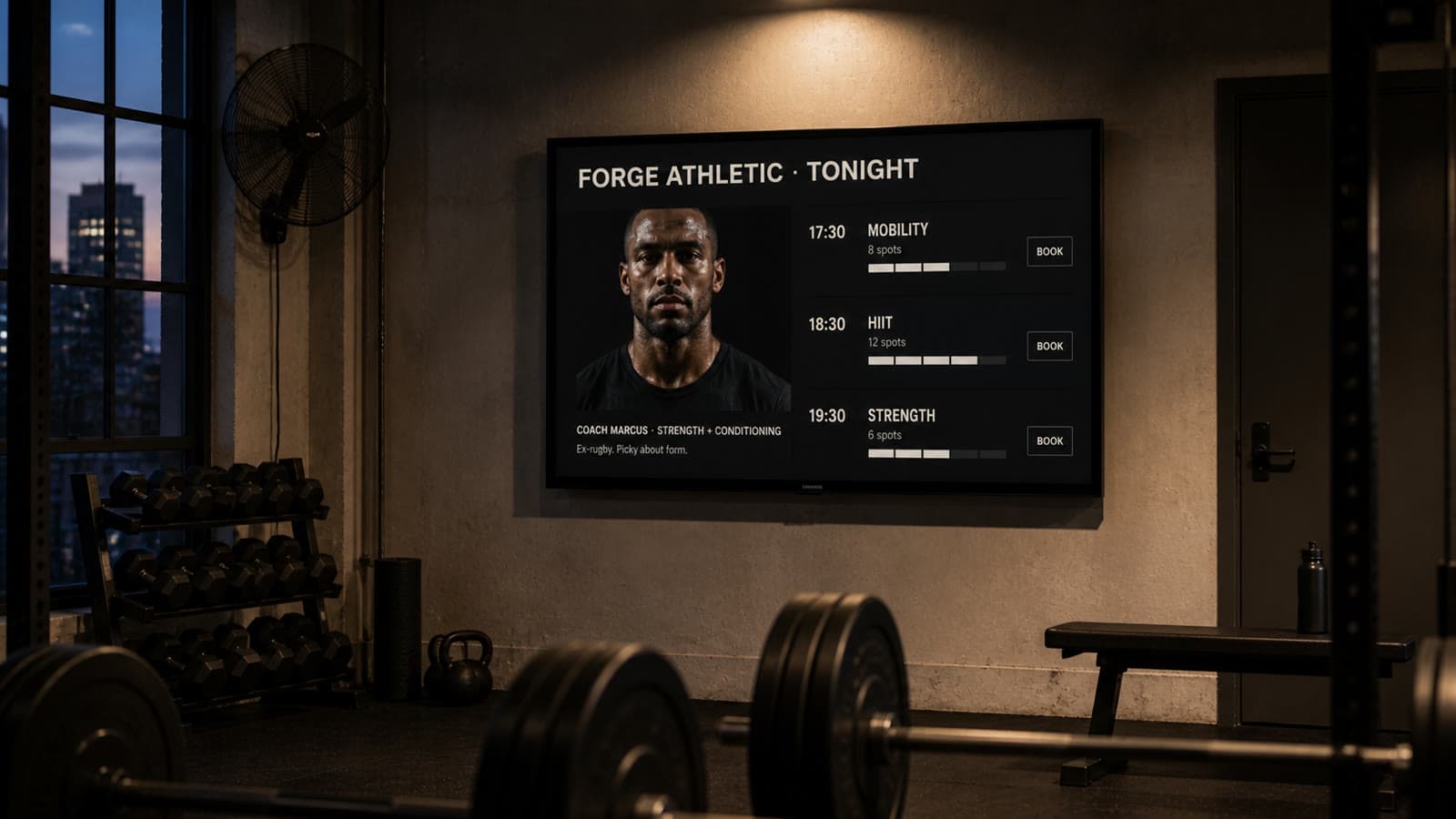
At a glance
- DOOH = digital out-of-home: screens outside the home, not on personal devices.
- It covers roadside, transit, retail and in-venue screens.
- Bought directly, through an agency or programmatically from a DSP.
- Measured by logged plays, an audience model and audits, plus QR scans for action.
What DOOH means
Out-of-home advertising began as the poster on the street. Digital out-of-home is the same idea on screens: a digital billboard by the road, a screen in a station, or the TV in a café. Because the screen is digital, the ad can change from one hour to the next and every showing can be recorded.
Most DOOH falls into four groups:
- Roadside: large digital billboards seen from the road.
- Transit: screens in stations, airports and on platforms.
- Retail: screens in shops and shopping centres, close to the shelf. See retail media.
- Place-based or in-venue: screens inside cafés, gyms, salons, clinics and offices, where people stay a while. See in-venue advertising.
DOOH vs OOH: what changes
| Classic OOH | DOOH | |
|---|---|---|
| Format | Printed poster or billboard | Video or still on a digital screen |
| Changing the ad | Reprint and re-hang | Upload a new file |
| Buying unit | A site for a period | Hours, plays or impressions |
| Targeting | The location | Location, kind of place, hour, weather |
| Proof | Photos of the site | A log of every play |
| Interaction | Rare | QR codes to a page, an offer or a game |
DOOH keeps what makes out-of-home work, a public screen nobody can skip or block, and adds the timing and reporting of digital media.
How DOOH is bought
There are three common routes. They often reach the same screens:
- Direct or self-serve. You book screens on the owner’s platform. On VERSE that is Ads Manager: choose the ad, where and when, and a budget from $1.
- Through an agency. The agency plans and buys for you and reports back. VERSE for agencies gives each client a workspace.
- Programmatic. A buyer’s DSP bids for plays automatically over OpenRTB. See programmatic DOOH, explained.
Prices are usually quoted as a CPM, the cost of 1,000 impressions. On VERSE, they start at $1 CPM and rise with demand for the place and the hour.
How DOOH is measured
A screen cannot see who looks at it, so DOOH is measured in layers. On VERSE:
- Proof of play. The VERSE TV app logs every play with its screen and time. That record is the proof of play.
- Impressions. Each play is credited with the people likely to see it, from our audience model for that place, hour and screen.
- Audits. Unannounced visits confirm that the ad is on, visible and playing.
Action is measured separately: a QR code on the ad reports each scan by screen, hour and weather, and the VERSE Pixel follows what people do on your site afterwards. For the bigger question, whether the campaign caused extra sales, see incrementality and holdout groups.
What DOOH costs
DOOH prices vary with the screen, the place and the time. Busy places and peak hours cost more, as they do in any media. On VERSE you see a competition label for each hour and a price that is fixed when you book; there is no minimum spend.
Making a DOOH ad that works
A DOOH ad is seen from across a room, often with no sound. A few rules help:
- One message, readable in a few seconds. Big type, high contrast.
- Up to 20 seconds on VERSE; a still image is fine.
- Both shapes: 1080 × 1920 portrait and 1920 × 1080 landscape. AI Studio makes both from one brief.
- A QR code large enough to scan from a seat, linked to a page that loads fast on a phone.
- A version for the weather or the hour, if it matters: weather-matched versions play first at no extra cost.
Who DOOH is for
Large brands use DOOH for reach. Self-serve buying with no minimum has opened it to small and local businesses too: a gym, a bakery or a new clinic can put an ad on the screens in its own neighbourhood, at the hours its customers are there.
For the people who own the screens, DOOH is a source of income. Read how venues earn from their screens.