At a glance
- Ads play on the TVs venues already use for menus and offers, between the venue’s own content.
- People are sitting or waiting, so they see the screen for longer than a poster they walk past.
- You buy by place and hour, not by the week. On VERSE, from $1 CPM with no minimum.
- Every play is logged by the screen. Impressions come from the player log, an audience model and in-person audits.
In-venue advertising in one minute
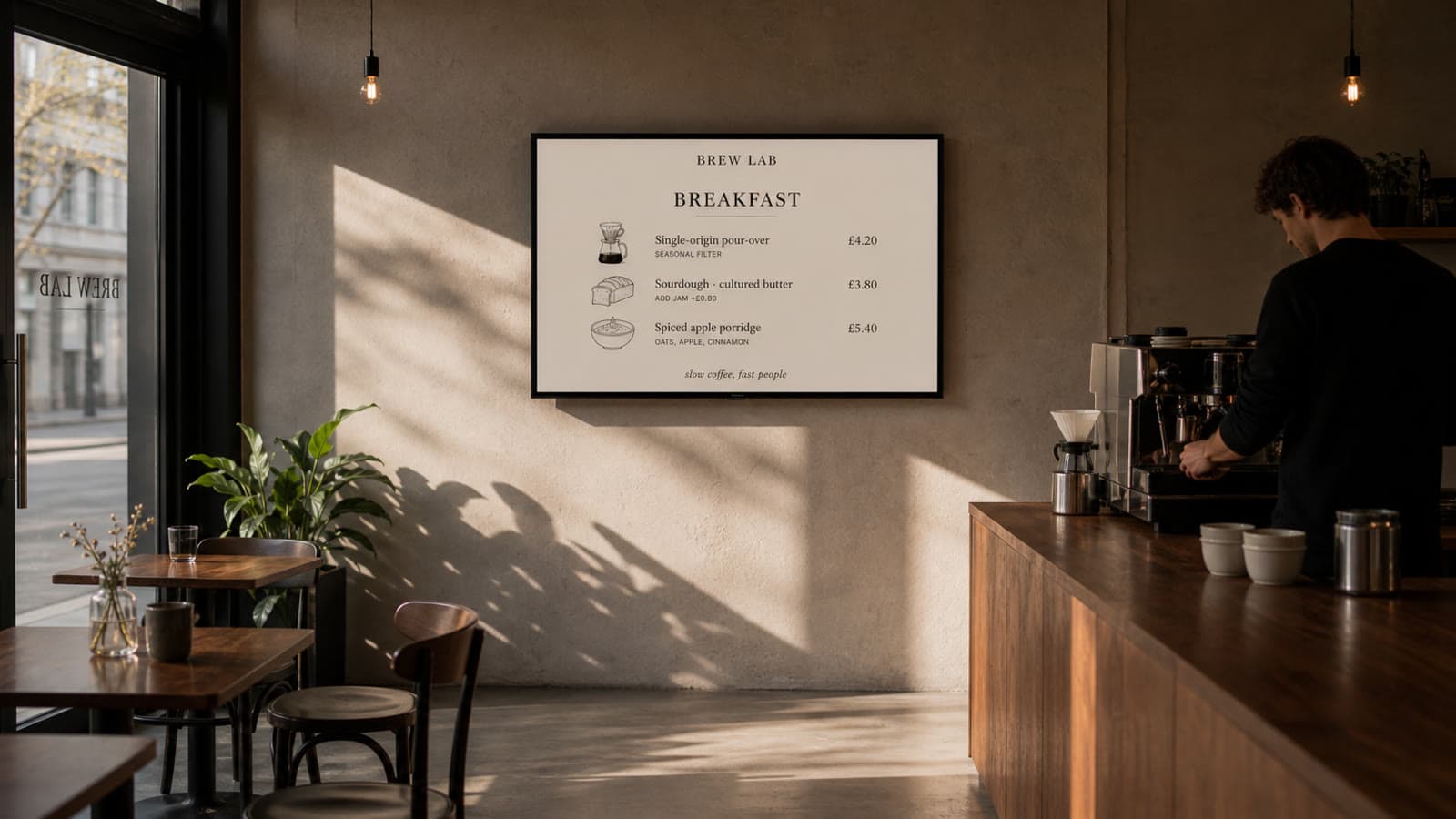
Walk into a café, a gym or a pharmacy and there is usually a TV on the wall. Most of the time it shows the menu, the class timetable or this week’s offers. In-venue advertising gives some of that screen time to brands: a short ad plays between the venue’s own content, then the menu comes back.
It is a kind of digital out-of-home (DOOH) advertising, sometimes called place-based media. What sets it apart from roadside screens is the setting. People are inside, often sitting down, and they stay a while: the dwell time is minutes rather than seconds.
Three parties share each screen. The venue owns the TV and decides how much time goes to ads. The brand books that time near its customers. The platform, here VERSE, runs the software, sells the time, logs each play and pays the venue its share.
Indoor vs outdoor advertising
Indoor and outdoor screens are both out-of-home media, but they are bought and used differently.
| Indoor (in-venue) | Outdoor (street, roadside) | |
|---|---|---|
| Where | Inside cafés, gyms, salons, shops, clinics, offices | Streets, roadsides, stations, bus shelters |
| Audience | People sitting, queuing or waiting | People walking or driving past |
| Time in view | Minutes | Seconds |
| Buying | By place and hour; on VERSE from $1 CPM, no minimum | Traditionally by site and by period |
| Proof | A log of every play, by screen and hour | Depends on the owner |
| Action | A QR code people can scan from their seat | Harder to act on while moving |
Indoor screens are closer to the moment of decision. A sports drink ad in a gym, or a lunch offer on the screen of the office lobby next door, reaches people a few steps from where they can act on it.
Where in-venue screens are
Almost any place with a TV and people who stay a few minutes can carry in-venue ads. Each kind of place has its own audience and its own best hours:
- Cafés: coffee queues in the morning, longer stays in the afternoon.
- Gyms: members between sets, before and after work.
- Salons and spas: clients in the chair for an hour or more.
- Pharmacies and clinics: people waiting at the counter or in the waiting room.
- Offices and coworking spaces: lobbies and kitchens at lunchtime.
- Shops and shopping centres: screens close to the shelf.
- Hotels, cinemas, campuses and stations.
VERSE is live in the UK and in venues across Tunisia. The network map shows the kinds of place that are live in each city.
How in-venue ads are bought
There are three ways to buy the same screens:
- Self-serve. In Ads Manager you make or upload the ad, choose areas, kinds of place and hours, and set a budget. The forecast shows the screens and plays before you pay.
- Through an agency. Agencies plan and buy for several clients from one workspace, with client reports and a journal of every change.
- Programmatically. Trading desks buy the same plays from their DSP over OpenRTB 2.6, by open auction, private marketplace or guaranteed deal. See programmatic DOOH, explained.
Whichever way you buy, the venue’s rules apply: ads only play in the time the venue gives, and the categories and brands it blocks never appear.
How in-venue advertising is counted
A screen in a café cannot count its viewers, so in-venue advertising is measured in layers:
- Every play is logged. The VERSE TV app on the screen records each play, with the screen and the time, even while the venue is offline.
- Impressions per play. Our audience model credits each play with the people likely to see it, for that place, hour and screen.
- Checked in person. Unannounced visits confirm that the ad is on, visible and playing.
On top of that, a QR code on the ad ties each scan to the screen, hour and weather it came from, and the VERSE Pixel shows what people did on your site afterwards.
What in-venue advertising costs
In-venue ads are usually priced by CPM: the cost of 1,000 impressions. On VERSE, prices start at $1 CPM and rise with demand for the place and the hour, so busy venues and peak hours cost more. You see the price before you book, and it is fixed once you do.
There is no minimum spend: you can start with $1 and pause whenever you like.
Examples of in-venue advertising
In-venue works best when the ad fits the place and the moment. Some ideas, as examples:
- A coffee roaster runs a new blend in cafés from 7 to 10 in the morning, with a QR code for a first-order discount.
- A sports drink plays in gyms after 5 pm, when most members train.
- A sunscreen brand adds a weather rule so its ad plays in pharmacies only on sunny days.
- A new restaurant shows its lunch menu in nearby office lobbies between 11:30 and 2, with a QR code to book a table.
- A business app reaches founders on the screens of coworking spaces during the working week.
Ads can be a video of up to 20 seconds or a still image, in portrait (1080 × 1920) and landscape (1920 × 1080). AI Studio can make both from one brief.
The other side of the screen: venues
For the venue, the screen is first a free sign. Screen Manager runs menus, offers and playlists on the TVs it already owns, from a phone. If the venue chooses to give some time to ads, that time pays it. Venues set the ad time each hour and block categories, brands and competitors, or keep their screens ad-free with a subscription.
Read how venues earn from their screens for that side of the story.